
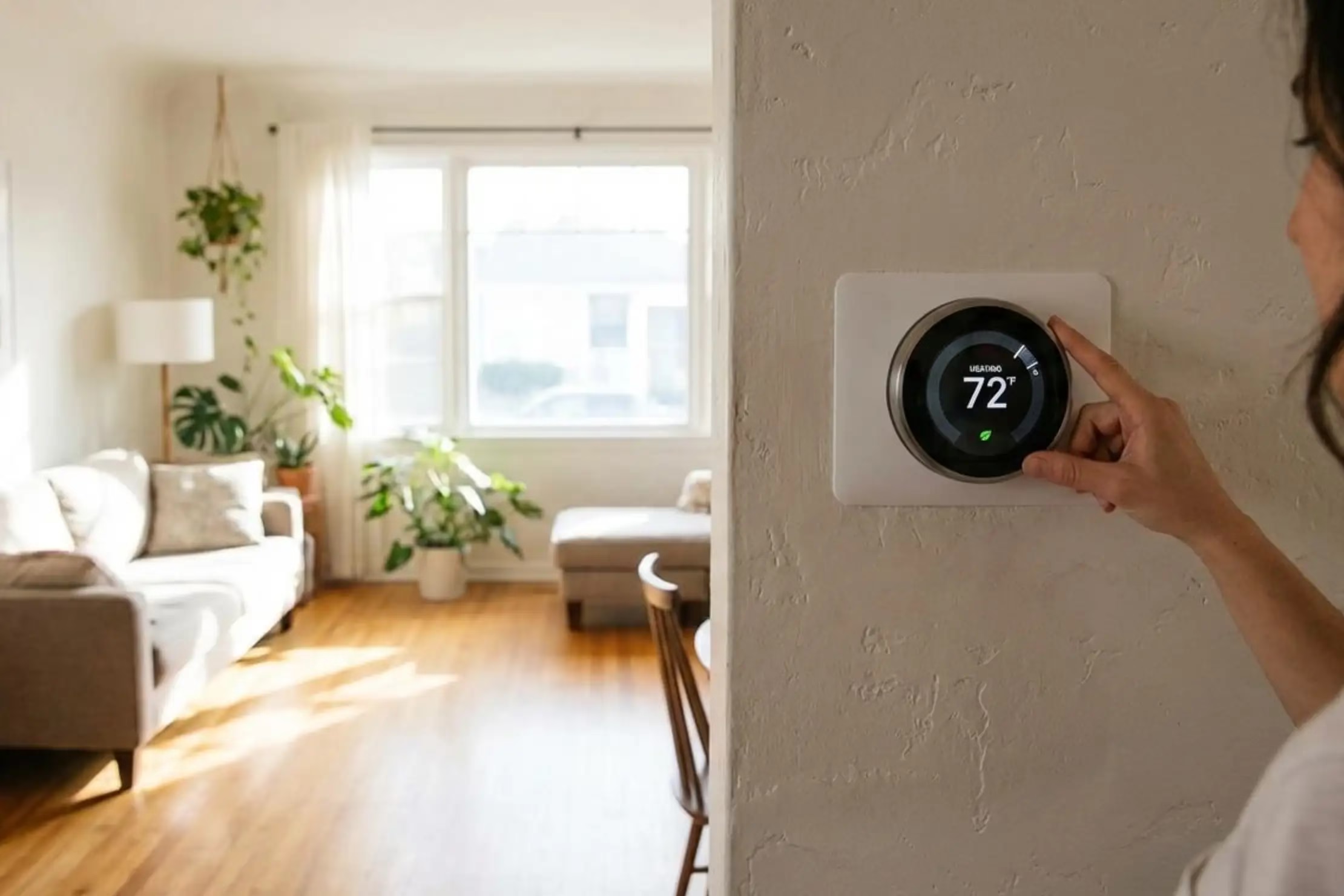
If you’re wondering what temperature should I set my thermostat to save money, the familiar starting points are around 68°F (20°C) for winter heating and 78°F (26°C) as a summer cooling benchmark. But those aren’t rules you have to follow regardless of comfort.
There’s a gentler approach: adjust your thermostat by just one degree. Lower it by 1°F in winter or raise it by 1°F in summer, then leave it there for seven days.
You don’t need to shiver through dinner, wake up sweating, or constantly adjust the dial. The idea is to discover whether a tiny change can reduce energy use without making your home feel noticeably different.
The Science of the Nudge: How Much Do You Save by Lowering Thermostat 1 Degree?
Does lowering your thermostat save money? Yes, generally, when your heating system has to maintain a lower indoor temperature. The reason is simple: the greater the temperature difference between your home and the outdoors, the faster your home tends to lose heat during winter.
Imagine your house as a warm cup of coffee on a cold morning. The bigger the difference between the coffee’s temperature and the surrounding air, the faster it cools.
Your home works similarly. Heat moves through walls, ceilings, windows, and other parts of the building toward colder outdoor areas. When you lower the indoor temperature slightly, you reduce that temperature difference. Your heating system has less heat to replace, which can mean less energy used over time.
The U.S. Department of Energy (DOE) estimates that turning your thermostat back by 7–10°F for eight hours a day can save as much as 10% annually on heating and cooling costs. DOE Guide to Energy-Efficient Home Upgrades
An older DOE home-heating guide also estimates approximately 1% savings on heating bills for each degree of thermostat setback maintained over an eight-hour period. However, actual savings depend on your climate, insulation, heating equipment, and how your household uses energy. It’s not a guaranteed percentage for every home. U.S. Department of Energy: Home Heating and Cooling Guide (PDF)
So, what does that mean for a one-degree adjustment? It means you can expect a modest reduction in heating or cooling demand, not a dramatic overnight drop in your utility bill.
The benefit is that the change requires almost no ongoing effort.
What Temperature to Set Thermostat in Winter to Save Money (and Summer)
The best temperature is one that balances comfort with energy use. Your home’s insulation, local weather, clothing, humidity, and daily routines all influence what feels comfortable.
Here are practical starting points.
Winter: A comfortable starting point around 68°F
The DOE’s traditional recommendation is to set your thermostat to 68°F while you’re awake, then lower it while you’re asleep or away from home.
If your household normally prefers 70°F, there’s no need to jump straight to 68°F. Try 69°F first. That small adjustment is the foundation of the one-degree nudge.
For sleeping hours, some households are comfortable with temperatures around 60–65°F, particularly with suitable bedding. Others prefer a warmer room. Treat this as an optional range, not a requirement. The ideal indoor temperature in winter depends on the people living in your home.
Summer: Start around 78°F
For air conditioning, the DOE identifies 78°F as a useful summer benchmark when you’re away from home. Its broader advice is to keep the cooling temperature as high as comfortably possible.
If you normally set your thermostat to 74°F, try 75°F for a week. A ceiling fan can help you feel cooler by moving air across your skin, allowing you to tolerate a slightly warmer setting without sacrificing comfort.
When you’re away
You generally don’t need to maintain the same temperature when the house is empty. Adjusting the thermostat while you’re away or asleep is one of the simplest ways to reduce heating and cooling demand.
However, avoid settings that could create problems with frozen pipes, excessive indoor heat, pets, or vulnerable household members. If you use a heat pump, check its manufacturer’s guidance before making large setbacks; some systems need compatible controls to avoid inefficient auxiliary heating. U.S. Department of Energy: Home Energy-Saving Guide

The 1-Degree Experiment: A Week Without Thermostat Wars
We’ve all seen the thermostat yo-yo.
Someone lowers the heating by five degrees to save money. A little later, another family member feels cold, turns it up, and suddenly the house is warmer than it was before the experiment started.
The problem isn’t a lack of discipline. It’s that an aggressive adjustment can make everyday life uncomfortable.
A one-degree nudge is a more approachable alternative. It gives everyone a chance to experience a small change without turning the thermostat into a household negotiation.
Here’s your seven-day experiment:
Day 1: Make one small adjustment.
- In winter, lower your usual heating setting by 1°F.
- In summer, raise your usual cooling setting by 1°F.
Days 2–6: Leave it alone.
Avoid repeatedly checking the thermostat or making adjustments out of habit. Notice how the rooms feel during ordinary activities.
Day 7: Check how comfortable everyone feels.
Ask yourself:
- Did anyone actually notice the difference?
- Did the house remain comfortable during meals, work, and relaxation?
- Did you feel the need to change the setting repeatedly?
If the adjustment felt perfectly comfortable, consider keeping it as your new baseline.
If it didn’t, there’s no reason to force it. You can return to your previous setting and try a smaller change at another time.

Why a Gradual Change Can Feel Easier
Thermal comfort isn’t determined by the thermostat number alone. ASHRAE Standard 55 considers several factors, including air temperature, humidity, air movement, clothing, and physical activity.
That’s why two people sitting in the same room can experience the temperature differently. Someone working at a desk may feel chilly while someone moving around the kitchen feels perfectly comfortable.
People can also adapt to changing indoor conditions through simple adjustments, such as wearing another layer, changing activity, or using a fan. But there is no scientific guarantee that a one-degree change will become imperceptible within 24–48 hours.
The practical lesson is simpler: make small changes, pay attention to how your household responds, and let comfort guide the decision.
The Relief Check: Comfort Comes First
Saving energy shouldn’t mean making your home a place where everyone counts the minutes until they can get warm or cool down.
The one-degree thermostat nudge is not about enduring discomfort or chasing a perfect utility bill. It’s about discovering whether a small, almost effortless adjustment can make your home a little more efficient.
Try it for seven days. If it works, keep it. If it doesn’t, adjust without guilt.
A comfortable home and a more manageable energy bill can coexist. Sometimes, the best place to start is just one degree away.