
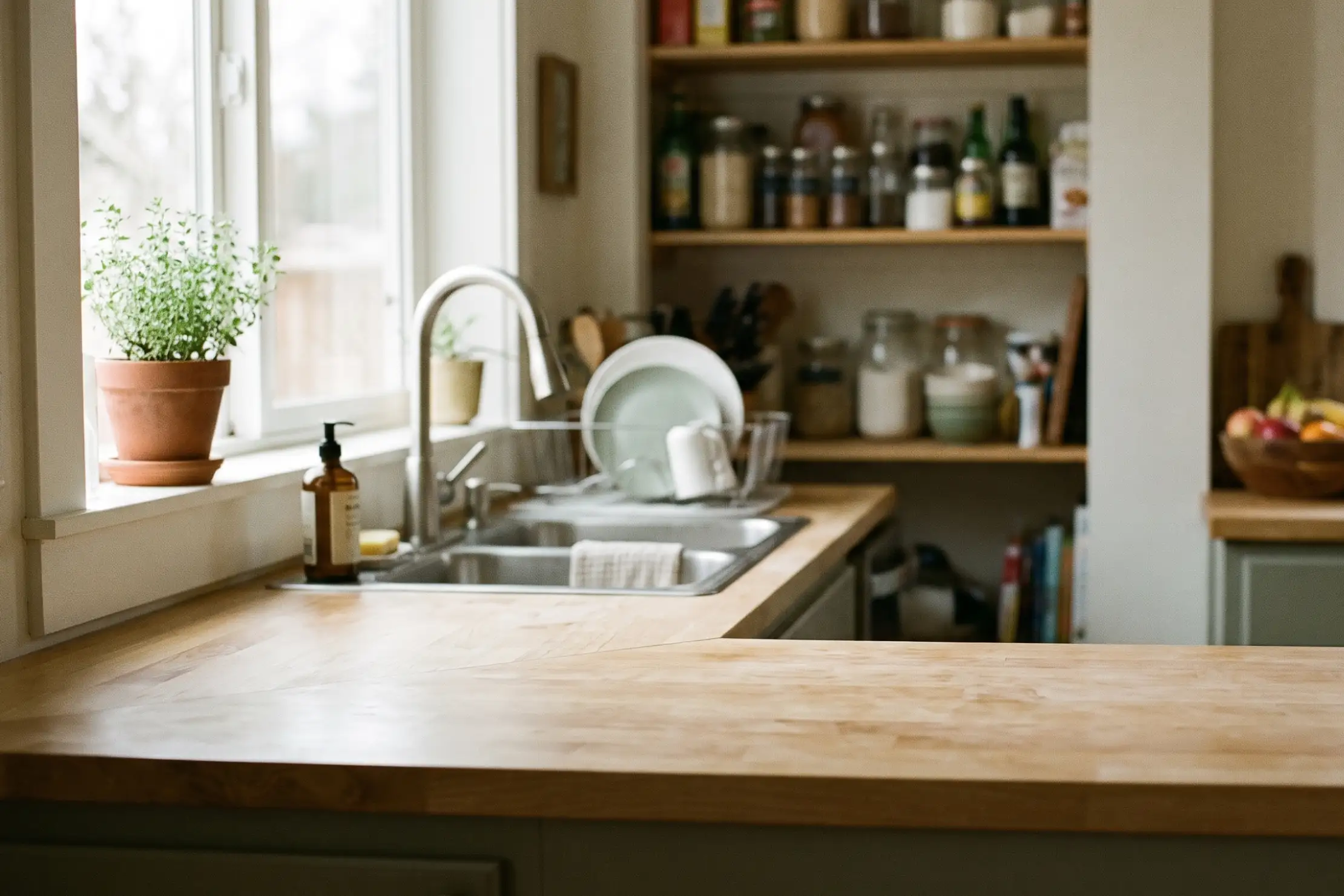
You walk into the kitchen and see yesterday’s mail, a few unwashed dishes, tangled charging cables, and items that never quite found their way home. You look around, take in the visual noise, and feel tired before you have touched a single thing.
If you have ever wondered how to start decluttering when overwhelmed, the answer is much smaller than you might expect. You do not need to clean the entire room, empty every cupboard onto the floor, or spend your Saturday in an exhausting organizing marathon.
You only need one clear surface.
Welcome to the One-Surface Sanctuary: a five-minute behavioral shift that gives your eyes somewhere peaceful to land, even when the rest of the room is still waiting.
Why Whole-Room Decluttering Can Feel So Overwhelming
A messy room rarely presents itself as a single chore. It presents dozens of competing decisions all at once.
There is a cup to wash, a receipt to file, a sweater to fold, a shipping box to break down, and a stack of papers that might contain something important. Every single object asks a question: Where does this live? Do I still need it? Should I keep it?
Before you know it, a task that started as simple tidying turns into severe decision fatigue.
This is the primary reason ambitious organizing weekends backfire. You pull everything out of a closet or cabinet with good intentions, but within an hour, the contents are spread across the floor. The physical mess has doubled, your energy is spent, and the room feels worse than when you began.
There is also an emotional trap: beginning with sentimental belongings. Old family photographs, children’s school projects, cards, and keepsakes require emotional energy that everyday maintenance cannot give them. If you are trying to figure out how to declutter sentimental items, save that project for a dedicated, quiet afternoon. You do not need to process memories while trying to make your kitchen usable. Everyday surface maintenance and deep emotional sorting are two entirely different jobs.
Your first job today is simply to make one small corner of your home feel lighter.
Why a Single Clear Surface Shifts Your Energy
There is a measurable reason an overfilled room feels exhausting even when you are sitting still.
A landmark study published in Personality and Social Psychology Bulletin, tracking dual-income spouses in their homes, examined how people described their domestic spaces alongside daily cortisol patterns. The researchers found strong associations between descriptions of a home as cluttered or unfinished and sustained patterns of stress-related cortisol, especially among women. While clutter alone may not be the sole cause, the daily visual atmosphere of our homes directly shapes our nervous system.
Researchers at the Princeton Neuroscience Institute observed a similar mechanism in visual processing. When multiple objects fill your field of vision simultaneously, they compete for representation in your visual cortex. The brain’s processing capacity is finite. A visually noisy environment continually drains subtle cognitive bandwidth in the background.
Think about your kitchen counter. When every inch is occupied, your eyes keep catching unfinished stories: the empty jar, the grocery receipt, the slow cooker you rarely use, the unpaid bill.
Now imagine a three-foot stretch with nothing on it.
It does not solve every domestic chore, but it gives your attention an island of quiet. You see a clear surface, you use it when you need to make a cup of tea, and you feel the relief of a finished space without needing to overhaul the entire house.
The One-Surface Sanctuary: How to Declutter Fast
Choose one flat, highly visible horizontal surface. Keep the physical boundary small enough that you can clear it in five minutes flat.
Good candidates include:
- A three-foot stretch of kitchen counter beside the sink
- The center of the dining table
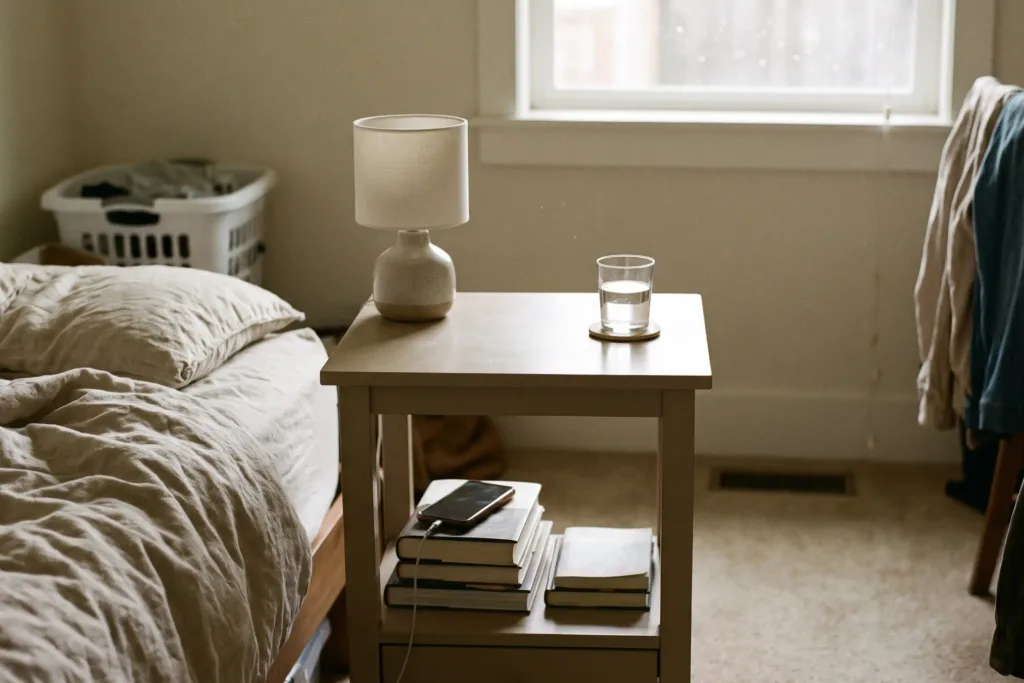
- Your bedside nightstand
- A section of the bathroom vanity
- The entryway console table
Do not pick an entire 15-foot kitchen counter if it is covered from end to end. Pick one defined zone. The tighter the boundary, the faster you finish.
Follow three friction-free steps:
- Move what does not belong: Put obvious items back where they live. If an item requires a complicated decision, place it in a temporary catch-all basket rather than stopping to deliberate.
- Wipe the surface clean: Give it a quick 30-second wipe down so the visual difference is sharp and tangible.
- Leave it completely clear: Resist the temptation to decorate it with a scented candle, fill it with storage organizers, or immediately start cleaning the next counter.
The goal is not to produce a magazine-perfect home. The goal is to build one reliable territory of order.
How to Declutter Kitchen Counters Without Buying More Storage
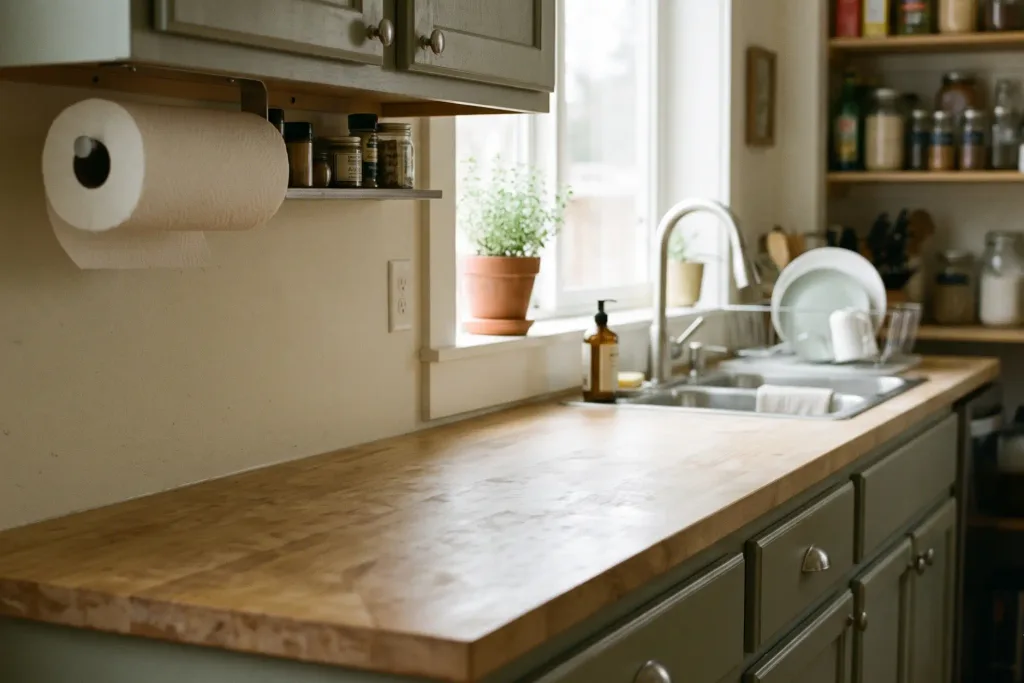
The kitchen is often the best place to practice this shift because flat counters are natural clutter magnets. They become the default landing pad for mail, groceries, pantry overflow, and appliances.
When kitchen counters are buried, preparing dinner carries an invisible friction tax: you have to wash dishes and clear prep space before you can even slice an onion. That friction is often what convinces an exhausted person at 6:30 PM to surrender and order an expensive takeout meal. Keeping just one prep zone clear makes cooking a quick pantry meal possible.
If you are learning how to declutter kitchen counters, begin with a simple boundary question: Does this item earn the right to live on prime horizontal real estate?
You rarely need more plastic bins. Often, the easiest way to solve how to declutter kitchen surfaces is to shift utility items off the horizontal plane entirely:
- Use a dish dry rack over sink: If your sink layout allows, an over-the-sink drying rack reclaims the substantial footprint a bulky drying mat normally steals.
- Elevate paper goods: An under the cabinet paper towel holder keeps a daily necessity within reach while freeing up direct counter space.
- Clear spice jars: An under cabinet spice rack keeps frequent seasonings accessible without letting them accumulate near your cutting board.
These adjustments are optional tools, not mandatory purchases. The lasting principle is simply keeping your flat workspaces free of permanent utility clutter.
How to Clean a Messy Room Without Doing Everything at Once
Once your surface is clear, your only job is to protect it.
For the next seven days, treat that boundary as an untouchable sanctuary. When an errant set of keys or a piece of mail lands there, move it along.
You will likely notice something interesting: a clear space subtly influences the area around it. You now have a quiet spot to set down a morning coffee, prep breakfast, or read a book. Because the contrast between that bare surface and the surrounding clutter is so clear, your awareness naturally sharpens.
This does not mean one clean table magically organizes an entire household. Family members will still leave items out, and busy days will happen. But you no longer have to wonder how do I get rid of clutter when life gets chaotic.
If you want to know how to get rid of clutter in your house sustainably, treat it as a series of small territories rather than whole-room battles. Once your first surface has stayed reliably clear for a full week, pick a second one.
Never before. You are building an effortless daily rhythm, not a stressful deadline.
The 7-Day One-Surface Experiment
Tonight, set a timer for three minutes.
Pick your single surface. Move what doesn’t belong, put away what has an obvious home, wipe the dust away, and step back. If an item brings up indecision, set it aside for another day.
Then stop.
For the next week, let that surface remain your quiet space. If life gets messy and something lands on it, simply clear it again without guilt.
At the end of the week, take note:
- Is that corner of the room easier to use?
- Does your eye naturally rest there when you walk in?
- Did clearing that spot give you a little more breathing room?
If yes, you can gently extend the boundary to a second surface. If not, simply enjoy the one you have.
A Peaceful Home Begins With Breathing Room
A calm home does not need to look like an empty minimalist showroom. Real homes hold laundry baskets, open books on nightstands, children’s toys, and dishes in the sink.
The purpose of decluttering is not to erase evidence of everyday life. It is to create enough quiet space that your home supports your rest instead of demanding your attention.
The next time you look around a chaotic room and wonder how to clean a messy room without losing your weekend, start small.
Find one surface. Clear it. Let it breathe. One small sanctuary is an immediate, complete victory all on its own.